Our story

We did not guess our way here. We were corrected by our own users.

A pilot in Migori taught us that advisory earns engagement but does not earn a business. We followed the evidence rather than defending the plan.

Chapter one

Migori, 2025

Shamba Salama began in Migori County as an AI advisory chatbot and market-access platform for smallholder farmers. Backed by a grant from the Kenya National Innovation Agency, we onboarded 54 farmers on a freemium model and achieved 80% retention. KeNIA published the results on its official blog. The grant funded chatbot development, a technical expert, and direct engagement with farmers and local agricultural officials.

Those are small numbers and we present them as small numbers. What they proved, though, is not small. Farmers will adopt a digital tool built in their own language for the phones they already own. Retention follows trust that was built in person. And a young team can ship working technology on grant capital.

It also proved something less comfortable.

What the pilot actually told us

Three assumptions, tested honestly.

What we assumedWhat happenedVerdict
Farmers will adopt a digital tool in their own language, on their own phones.54 onboarded, 80% retained on a free tool with no enforcement mechanism. Sustained voluntary use is the strongest signal available at that scale.Confirmed
Trust can be built remotely, through a digital channel alone.Retention followed relationships built face to face with farmers and local agricultural officials, not the channel itself.Partly wrong. The in-person layer became structural, not optional.
Free advisory content can be converted into farmer-paid revenue.Engagement was real and repeat use was strong, but it never converted into willingness to pay a subscription. Smallholders cannot and should not carry fees for information.Wrong. This finding caused the pivot.
Chapter two

The pivot, 2026

We did not adjust the pricing or retry the same model with better messaging. We changed the business.

We moved from advisory to protection. The highest-value moment for a farmer is not a tip during the season. It is the warning that arrives before the flood. The product was rebuilt around farm-level flood and drought alerts with 48 to 72 hours of lead time.

We moved the payer. Alerts became free permanently, and revenue now comes from index-insurance distribution, where established underwriters pay for last-mile reach they cannot build themselves. The farmer stopped being the customer and became the beneficiary.

We made the in-person layer structural. Because trust turned out to be relational rather than digital, community champions, village learning circles and Dholuo radio became customer-acquisition infrastructure rather than outreach activity.

We deferred the marketplace. Market access was part of the original platform. It now sits behind the alert and insurance layers, because owning the farmer relationship has to come first.

Advisory earns engagement. Protection earns a business.

Why now

Four doors opened at once.

01

Kenya put insurance at the centre

In 2025 the government embedded index insurance directly into the national fertilizer subsidy, targeting 250,000 farmers across eleven counties including Migori. That created the largest cohort of first-time policyholders in Kenyan history: auto-enrolled, but not yet educated, engaged or likely to renew.

02

Regulation caught up

Kenya's Insurance (Index Insurance) Regulations 2025 formalise parametric products and compel payout within ten days, removing the delays that historically poisoned farmer confidence in the whole category.

03

Early warning became a funded priority

The UN's Early Warnings for All initiative targets universal coverage by the end of 2027, and the Global Commission on Adaptation finds early-warning systems return roughly nine dollars of net benefit per dollar invested, the highest of any adaptation measure assessed.

And fourth: sub-Saharan Africa needs around US$51 billion a year in adaptation finance and received US$12.9 billion in 2023. Between 2014 and 2018 under half of committed funds were actually disbursed. Billions are searching for trusted local infrastructure that can prove delivery. Our metric was purpose-built to be that proof.

The ground

Rongo first. Nyakach next.

Our December 2026 deployment runs in Rongo, Migori County, and we chose it for an unglamorous reason: it is where we are headquartered, where our existing farmer relationships sit, and where the original KeNIA pilot ran. The honest answer to "who is readiest to engage now" is the community that has already given us a hearing.

Nyakach Sub-County, on the Winam Gulf of Lake Victoria, is the scale site that follows. It is a frontline climate community of roughly 175,000 people, overwhelmingly smallholder farming households, that has recorded five major flood events in ten years alongside lengthening dry spells. Agricultural productivity there has declined an estimated 35% in a decade, more than a third of households are food-insecure in lean seasons, and fewer than 12% hold any agricultural insurance.

Every Nyakach figure we publish is a target, in future tense, with a date. We would rather discover a broken assumption in Rongo with fifty farmers than in Nyakach with two thousand.

Three people, one plan

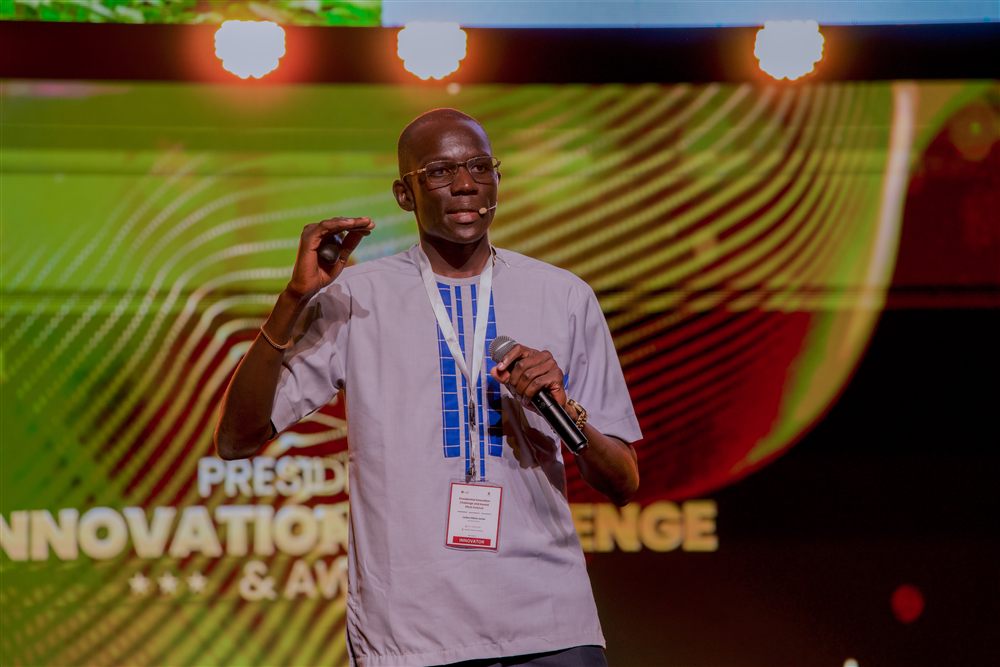
Collins Otieno Junior pitching Shamba Salama at the Presidential Innovation Challenge and Award Pitch Festival, 2025PIA Pitch Festival, 2025

Collins Otieno Junior

Founder & CEO

Raised in a Migori farming family. Software engineering graduate, now studying Data Science and Analytics at USIU Africa. beVisioneers Fellow and Equitech Futures Scholar. Built and delivered the KeNIA-backed pilot. Migori County Winner, 2024/2025 Presidential Innovation Challenge and Award.

Portrait to come

Bradley Agwa

Chief Technology Officer

Data scientist. Owns platform architecture, the alert engine, and the data infrastructure that the behavioural dataset is built on.

Portrait to come

Doreen Vivi

Chief Growth Officer

International Business Administration student at USIU Africa, concentrating in Marketing. Leads business development, partnerships, communications and the fundraising pipeline.